
What If We Saw the Person Before the Problem?
Scripture: Luke 10:25–37
Seeing the Person on the Road
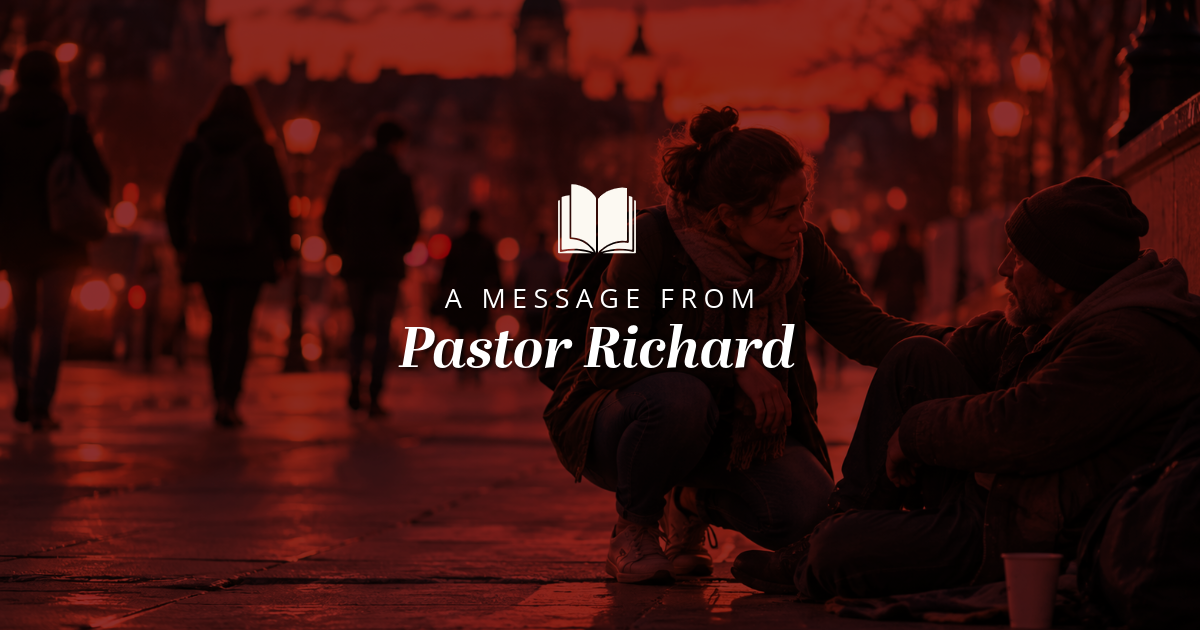
Most of us know the story of the Good Samaritan. A man is attacked and left injured along the road, where a priest and a Levite see him but continue on their way. Then a Samaritan, someone Jesus' audience would never have expected to become the hero of the story, stops.
We often focus on the Samaritan and his extraordinary compassion. But what happens when we shift our attention to the person lying on the road?
Before this person became "the victim," there was a life. There were relationships, ordinary routines, hopes, plans, and people who cared about what happened next.
This morning, actresses from Grosse Pointe Theatre helped us consider that perspective through a scene from Stop Kiss. We were given a glimpse of two people before an act of hatred changes everything.
Suddenly, the person on the side of the road becomes harder to overlook.
The One Who Wasn't Expected to Stop
In Jesus' parable, a priest approaches the injured man, sees him, and passes by. A Levite does the same.
Then comes the Samaritan.
The hostility between Samaritans and Jews makes his response even more striking. According to the expectations of Jesus' audience, this was not the person who should have stopped. Yet the Samaritan sees the wounded man, cares for him, takes him to an inn, and promises to cover whatever additional care he needs.
Jesus turns everyone's expectations upside down.
The person considered an outsider becomes the neighbor.
But there is another uncomfortable part of this story. Jesus also asks us to consider how easily we become the people who keep walking.
When We Choose the Other Side
It is easy to imagine that we would stop. Yet there are many ways to pass someone by without physically walking around them.
We can look away from suffering because we're busy. We can convince ourselves that someone else's pain isn't our responsibility. We can allow our traditions, assumptions, or beliefs to prevent us from recognizing another person's humanity.
Sometimes we go even further.
We ask what the victim did wrong. Why were they there? Why did they wear that? Why didn't they make a different choice?
Instead of helping carry the burden, our words add weight to it.
The Good Samaritan holds a mirror up to us. It asks us to remember the times we saw suffering and chose not to become involved.
That realization can be uncomfortable, but guilt is not where Jesus leaves us.
A Faith That Gets to Work
Jesus gives us another way forward: become the neighbor.
The Apostle Paul writes, "For the whole law is summed up in a single commandment, 'You shall love your neighbor as yourself.'" Love of neighbor is not simply a nice idea for Christians to admire. It asks something of us.
It requires what we might call a working faith.
A working faith rolls up its sleeves. It understands that compassion can be inconvenient and that caring for another person may require us to get involved in situations that are complicated or uncomfortable.
We will not always get it right. Part of faith is recognizing the moments when we have failed to see someone, repenting, and resolving to respond differently the next time.
Because our neighbor is not simply the person who looks like us, agrees with us, worships like us, or lives like us.
Our neighbor is the person in front of us.
May We Never Pass on the Other Side
The Good Samaritan asks us to see before we judge.
To notice before we dismiss.
And when someone has been bruised by life, hatred, violence, loneliness, or injustice, to have the courage to stop.
This is where faith becomes visible. Not merely in what we believe, but in how we respond when another human being needs us.
May we have the courage to act, the compassion to care, and the wisdom to recognize the humanity of every person we encounter.
May we never pass on the other side.
Reflection
Who might God be asking you to truly see instead of passing by?
Join Us on Sunday
Worship 10:00AM
